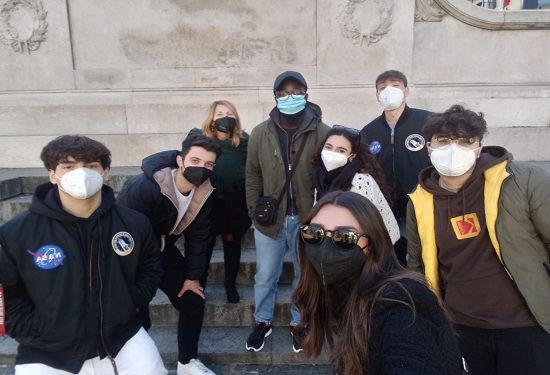
Last 23rd January my classmates and I met a migrant who has been living in Naples but working in torre Annunziata for long time. You have probably seen him many times walking down Piazza Ernesto Cesaro (Torre Annunziata). He stands there , outside the historical bakery “ Nunziatiello”. A kind, reserved and polite person who with gentleness shows his hand more to attract people’s attention than to beg for alms.
He is F.(we won’t reveal his full name) an immigrant from Nigeria who decided to emigrate from his native land and to come to Europe, as most of the immigrants/migrants, looking for better living conditions. The meeting was arranged by our English teacher who had met him many years before and who like to talk with him who can speak English but can’t Italian very well in order to get more in touch with immigrants-related topics and to experience in first person what these people have to overcome in order to survive. The interview took place in Piazza Santa Teresa, Torre Annunziata. Our interviewee, was born in Nigeria and, unfortunately, his sight started to deteriorate when he was young: this poor health condition caused him incessant headaches that had to be resolved.One day he sold everything he owned and started his never-ending journey in search of a better life. F was able to afford a one-way leg to Libya and there he worked for one year in order to earn the money needed to pay for a “seat” on a human beings smuggler-owned boat directed to Italy. He left Nigeria in early 2014 only to reach Europe in late 2015. He remarked that during the first leg of his trip from Agades, Nigeria, to Libya “the suffering was so mighty”. F says that a lot of people died and they encountered thousand of dead bodies along the road. He described us that they had no food and little water daily and still thanks God for having arrived to Libya alive. In Libya gangs in the districts enforce their own laws and then he added that, in Libya, neither authorities could be count on.
 The last leg of its trip, crossing the Mediterranean in winter (Libya and Sicily are almost 500km apart), was the most frightening. The interviewee remembers that they were “about 24” and went out at sea on Christmas Eve and the sea was really rough. Suddenly, the boat started to take on water and everybody started crying .He started praying God He was finally rescued by an NGO and he was told by a crew member that 4 boats were spotted leaving Libya that night but, unhappily, they were not able to find the others. Once he arrived to Italy, he was relocated in a refugee camp outside Naples. In Naples he did not know were to go and what to do in order to earn some money. After some time, he started looking for a job and he managed to earn something, under the table of course. F reported that, often, the payer would promise a payment of 50€ a day but, in the end, after the work was done, would give him only 20€. His sight problem grew worse every day. Anyway his opinion about immigrant is that My point being is that there is a lack of policies and State interventions. Immigrants are left alone to survive, and, if they are lucky they end up begging in order to eat at the end of the day. Disappointingly, these beggars are often judged and defined as “useless to society”, F told us to remark this aspect: “Before judging somebody, try to know (him/her), ask him a question: Why are you suffering?”. Probably, after the pandemic, our society lost its ability to be empathetic and we are only capable to look after our own garden, not realising that there a lot of people without a garden at all. Looking to what he overcame, and what others migrants had to go through, we should make a step back while being safe at our houses, surrounded by our loved ones, and we should comprehend at its fullest this statement: “Be the change you wish to see in the world”: this Gandhi’s quote has never been so true!
We should start with ourselves.