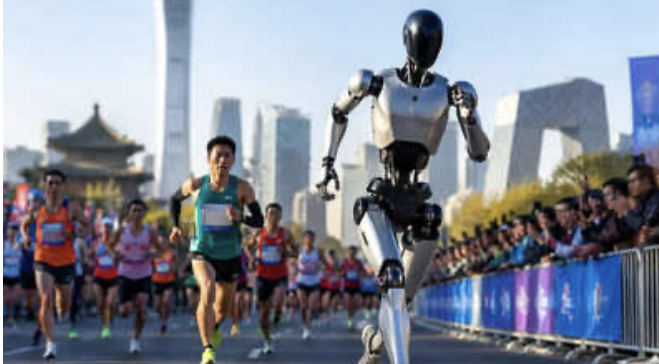
Yesterday evening, while watching RAI, I came across somethingthat quietly stayed with me long after the program ended. It wasn’tpresented as shocking or extraordinary. In fact, the tone wasalmost calm, as if what I was seeing had already become part of our world. A robot running a marathon.
The event took place in Beijing, where humanoid robots joinedhuman runners in a long-distance race. Among them, one stoodout: a robot capable of completing the course with remarkableefficiency and balance. Watching it move was strange, not becauseit looked clumsy or unnatural, but because it didn’t. Its steps weresteady, almost confident, as if running was no longer somethingthat belonged only to us.

What struck me most was not the technology itself, but how easilyit fit into the scene. There were no dramatic reactions, no sense of disbelief. Just runners, human and artificial, sharing the sameroad. It made me wonder: at what point do we stop seeing theseinnovations as “future” and start accepting them as part of everyday life?
Robots like these are the result of years of research in artificialintelligence and engineering. They can calculate movements, adapt to terrain, and maintain balance in ways that wereimpossible not long ago. In some ways, they represent the best of human creativity — our ability to solve problems and pushbeyond limits.
But there is another side to consider. If machines can run, think, and learn, what will remain uniquely human? Will we measureourselves against them, or will we redefine what it means to be human altogether? There is also the question of dependence: astechnology becomes more capable, we risk relying on it too much, losing skills we once considered essential.
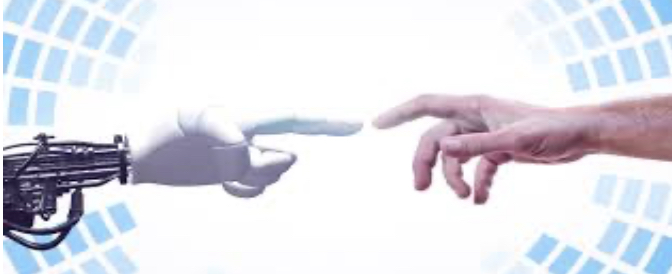
At the same time, it would be unfair to see this progress only as a threat. Artificial intelligence and robotics have the potential to improve our lives in countless ways — from medicine to environmental protection, from safety to accessibility. A robot running a marathon might seem symbolic, but it is also a sign of how far we have come.
In the end, what I saw was not just a race, but a symbol of the future. A future that can be both positive and negative—depending on how we decide to guide it.