Tag: UK

  • Brexit: what will change now?

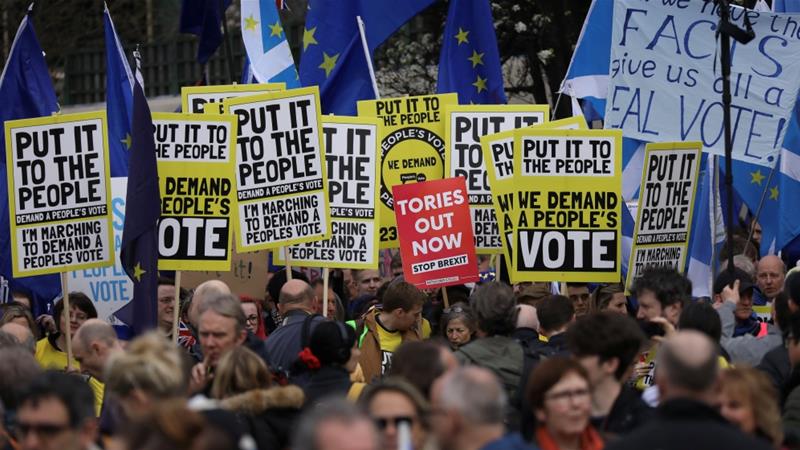
    Brexit: what will change now?

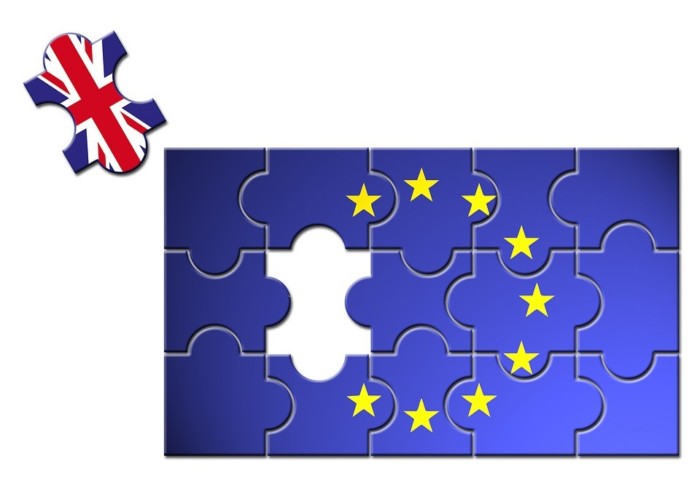
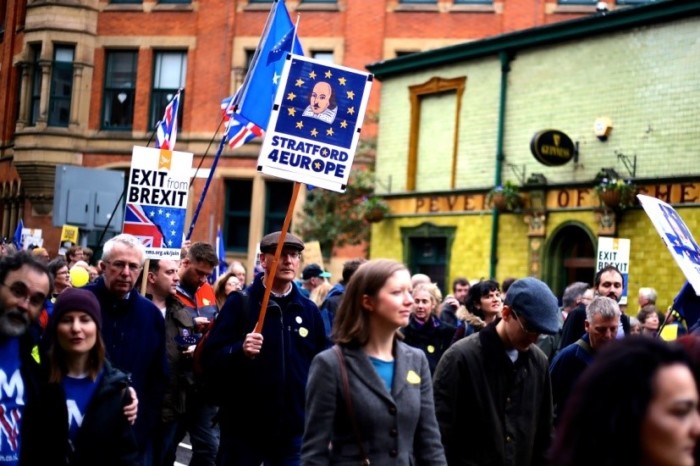
    It all started in 2013, Prime Minister David Cameron promised a national referendum on European Union membership with the idea of settling the question once and for all. The options were: Remain or Leave, and Mr. Cameron was convinced that Remain would win without impact.

    That turned out to be a serious miscalculation.

    As Britons went to the polls on June 23, 2016, a refugee crisis had made migration a subject of political rage across Europe that was widely used to make propaganda by the Conservative party in the UK.

    Most voters in England and Wales supported Brexit, particularly in rural areas and smaller cities. That overcame majority support for remaining in the European Union among voters in London, Scotland and Northern Ireland. Young people overwhelmingly voted against leaving, while older voters supported it. This is because the elders didn’t know the disaster which they voted for instead of the young people who knew the problems that the Brexit will lead.

    But how this happened? Leaves won for a single reason: the UK’s elders citizen ignore what EU is and what open borders are. The EU apply strict laws for breeding and agriculture, those laws brought a lot of problems for small farmers, that are most of the UK population. The solution was obvious: leave the EU. Without EU means no strict laws, it sounds easy, no?  Well no, without EU’s contribution now who will give the fund for agriculture? And most important, if UK’s government blocks all the importation from the EU, as a result all the UK’s exports will be blocked by the EU, and where these products will be sold? Nowhere. It’s like a dog biting its tail.

    Furthermore, London if laws change, will lost all of its power in terms of economics and all the international society headquarters will be transferred to other cities like Paris or Milan.


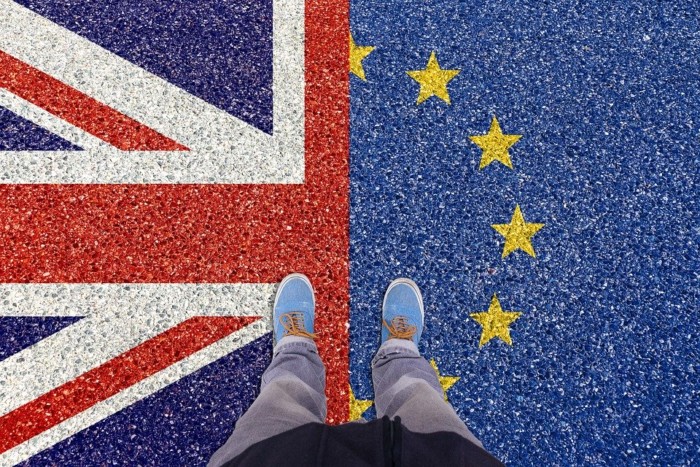
    Three years have passed since Brexit, the so-called referendum which led the United Kingdom out of European Union. At 24:00 of 31 January 2020 the UK is official out of the UE and the questions now is: what’s changed and what will change?

    The most important change is in the European’s economy and in the European stability. Those changing are due to the void created by the UK in the EU’s balance: UK left a void of about 13 billion Euro, now this void should be filled by other Countries, this mean that every European State should contribute with enough money to fill this void. Also, the total EU’s GDP (Gross domestic product) has shrunk significantly, in fact the UK was one of the European economies’ work horse. Besides, the same UK, if closed economy and customs come back in England how it was in 1950 will supposedly lost about 20/25% of its total export.
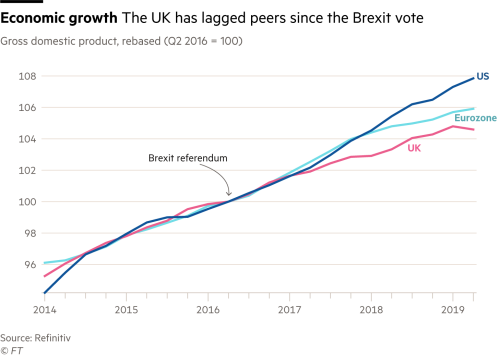
    Economy isn’t Brexit’s worst part.

    The EU could have led “a lot of immigrations problems” as said UK’s Prime Minister Boris Johnson, but it’s thanks to EU that nowadays we have open borders and we can travel in every state member only with our ID Card and without visa.

    If things change, and they will; travelling, working, studying and other thinks in the UK will become a nightmare.

    What you’ll need to enter the UK

    Until  January you could take a plane, land in Heathrow and only because you’re an EU citizen you didn’t have to pass customs because is like you have never left your state. You just need you ID.

    What you’ll need to enter the UK will not change until at least 2021.

    EU citizens can continue to travel to the UK for holidays or short-term trips, without needing a visa but they’ll need to show a valid passport.

    UK’s Premier as already said that they are working to create a copy of the United States’ ESTA (Electronic System for Travel Authorization), this mean that if you want to go to UK you need a visa from the English Foreign Office. Fortunately, EU and UK are still arguing on how set new laws for this Brexit.
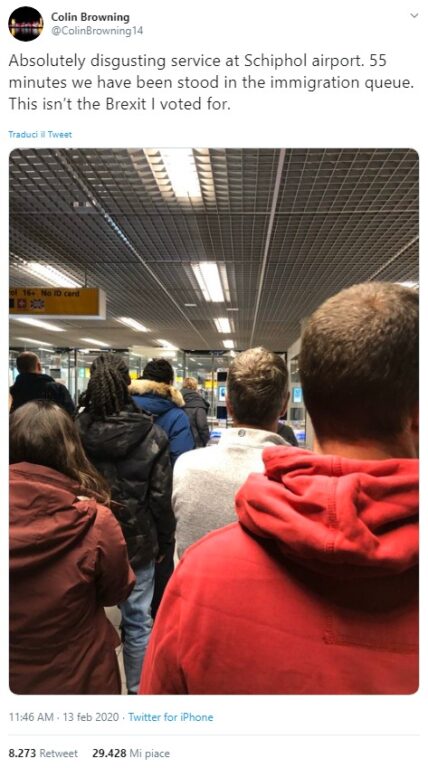
    In the last days has already been a case of chaos at Schiphol: the airport of Amsterdam. An English passenger who used to fly usually between UK and Amsterdam complained about the queue for the visa controls via Twitter. Schiphol’s official account replied stating that the queue was only for “new staff members trained yesterdays”.

    What will UK visitors need to enter EU countries?

    Visitors from countries with visa-free agreements with the EU (including the UK) will not be able to enter the Schengen Area with only their passports. The EU Commission has confirmed that UK citizens will need to pay a fee to visit Europe and will need to complete the online ETIAS (European Travel Information and Authorization System) form.

    New Immigration policy

    Just today, the UK announced that they will follow the Austalian method, is well know that Australia is a closed country and if you want to work there you need a specified visa and the European ID cards will not be accepted anymore. Those new immigration policies will became effective from the  January 2021.

    Priti Patel, UK’s foreign minister, said that its State will give the highest priority to most qualified peoples, like scientists and top talented students at one condition: they should speak and write in English without problems. And most important, they will eliminate “a immigration system distorted by European freedom of movement”, as Johnson said.

    Probably the most important measure refers to job’s visa, from this date if you’re looking for a job in the UK: look away. Because from this date you must already have a job in the UK with a salary at least of 30,000 € per year to be admitted to work. They also specified that EU’s citizen will be managed as all others immigrants who are searching a new job in England.

  • Be my Valentine

    Be my Valentine

    We know that 14 February is celebrated as a day of love, friendship and admiration, but why do we celebrate this day? This significant cultural, religious, and commercial celebration of romantic love has an ancient origin.

    The Catholic Church recognizes two different saints named Saint Valentine, both martyred. A legend says that Valentine was a Catholic priest who lived in Rome at Emperor Claudius II’s time. Claudius was pagan and decided to ban marriage for young people and soldiers because he believed they should be completely devoted to Rome. St. Valentine continued secretly to celebrate weddings for young lovers. He was found out by Emperor Claudius and executed on February 14 in the year 270.According to   another legend, an imprisoned Valentine (as a Christian) had sent the first greeting of “Valentine’s Day” after falling in love with a girl. Before his death, he is said to have written her a letter signed “From   your Valentine”.

    It wasn’t until more than 200 years later that 14 February was proclaimed St Valentine’s Day. By this   time Rome had become Christian but a pagan fertility ritual was still held in the middle of February each year (Lupercalia).

    Pope Gelasius abolished this pagan ritual and proclaimed 14 February Saint Valentine’s Day, thus establishing this feast day on the Catholic Calendar of Saints.

    The poet Geoffrey Chaucer in   the Middle Ages was the first to link St. Valentine with romantic love. This was the beginning of the tradition of courtly love, a ritual of expressing love and admiration, usually in secret. Historians believe that these meetings were in fact gatherings where people read love poetry and played games of flirtation. When we think of Valentine’s Day we also think of Shakespeare. He is the spokesman of our   culture   on   the   theme   of   romantic   love. Many   phrases on Valentine’s   Day   cards   are quotes from this author. The famous sonnets of the love theme are: Sonnet 116 “Let me not admit impediments to the marriage of true minds” and Sonnet 18 “Should I compare you to a summer day?”

    In Britain, Valentine’s Day began to be popularly celebrated around the 17th century. It was typical for friends and lovers to exchange message of love and small handwritten cards. In 1900 beautiful printed cards and gifts of flowers were being exchanged. But still today all over the world many couples choose to celebrate their Valentine’s Day with exchanging romantic cards, gifts, flowers or having dinner, a picnic or special home-cooked meal.

    If I am still on time, I suggest to take inspiration by Shakespeare’s romantic sonnets in case of you are running out of ideas. Your beloved will be amazed by your ability in expressing your deep love.

    By the way!  Never forget that Cupid can be sometimes wrong!

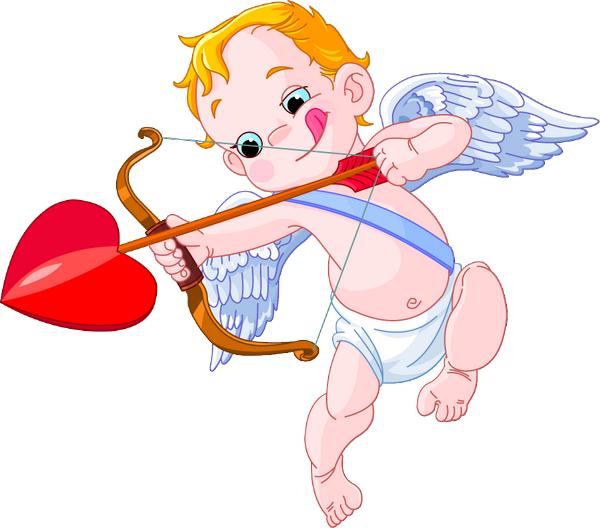
    Cupid is one of the most popular symbol of love often associated to St. Valentine day. He is considered a flying child with a bow and arrow, but his origins go back to Greek mythology. The god of love and desire was a hunter who pierced people with his love arrows to create unwanted and affections. Cupid, the playful god of desire and attraction in the classical world is now shooting his arrows in cards all over the world.

    If you are still looking for Love or, your Love is hopeless, I suggest to go to a town named: San Valentino Torio in the province of Salerno in the Campania region of south-west Italy.

    A statue of St.  Valentine in the Church of San Giacomo Maggiore is waiting for you to accept and to fulfil your desires but, don’t be too fussy and have a careful look around, your Valentine may be just round the corner.

  • “A new dawn rises on a new day” or the sun sets….?

    “A new dawn rises on a new day” or the sun sets….?

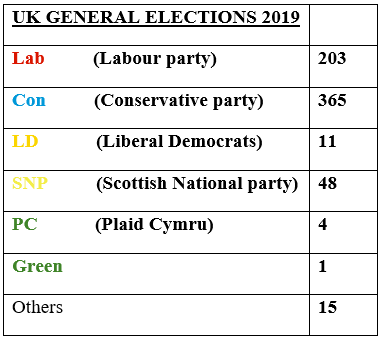
    The Conservative Party (right-wing) or Tories, as it is usually said after centuries, won a majority in the General election in the U.K on 12th December 2019.  It won exactly a total of 365 seats declared and will form the next Government after securing an overall majority.

    The leader  of the Labour party (left-wing) Jeremy Corbyn  announced he will not lead Labour into another election after his party suffered humiliation and admitted it was  a “very disappointing” night .

    The SNP (Scottish National party) gained 48 seats (beyond all expectation) defeating the Liberal Democrat (centrist) leader Jo Swinson who won only 11 seats and declared that it was a real disappointing night for her party.

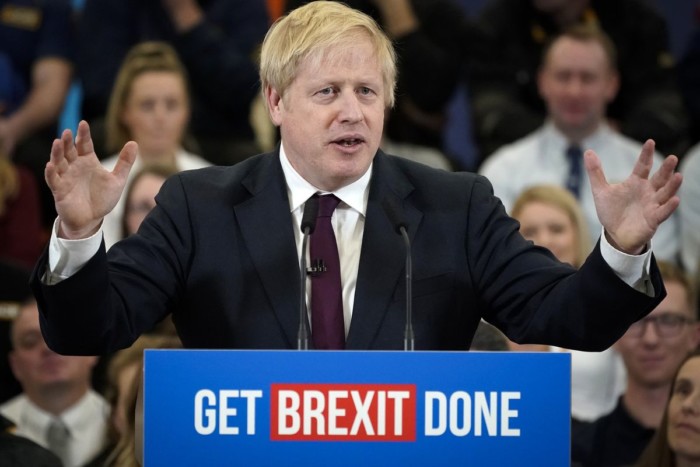
    But the big winner was Mr Johnson, Boris Johnson the current UK Prime minister (Bo Jo, as tabloids often call him) as the Tories won seat after seat in Labour’s heartlands.

    The result gives Johnson a comfortable majority in the House of Commons and paves the way for Brexit to take place at the end of January. The Tories’ main campaign promise is to do what  Mrs May failed to do, and what Mr Johnson has made his mission as Prime minister, to get Brexit done.

    Mr Johnson’s mood is much more upbeat as he thinks his new government will be the chance to respect the democratic will of the British

    people to change the country for the better and to bring out the potential of the entire people of his country.

    And then goes the question, why did most of people from UK vote Conservative?

    According to surveys the answer is that they want to preserve their history, their culture, their heritage, their own values but above all they want the control of immigration because that’s their idea of democracy or something like that. Actually, they want immigration down because they think it will be the only way to go back living a decent life, to take their jobs, their houses, their identity and above all their country back. There is no objection to protect culture but all this can’t be justified with their control over immigration. Control is a national prerogative but nations can be constructed on a specifically non-ethnic basis, but it is important bring together different cultures. Conservatives should spend more time discussing and thinking about assimilation, recognize the economic benefits of immigration and admit that immigrants can also bring youth, innovative ideas and talent to UK economy, Change is not something to be imposed by others.

  • LET’S TALK ABOUT THE WEATHER!

    LET’S TALK ABOUT THE WEATHER!

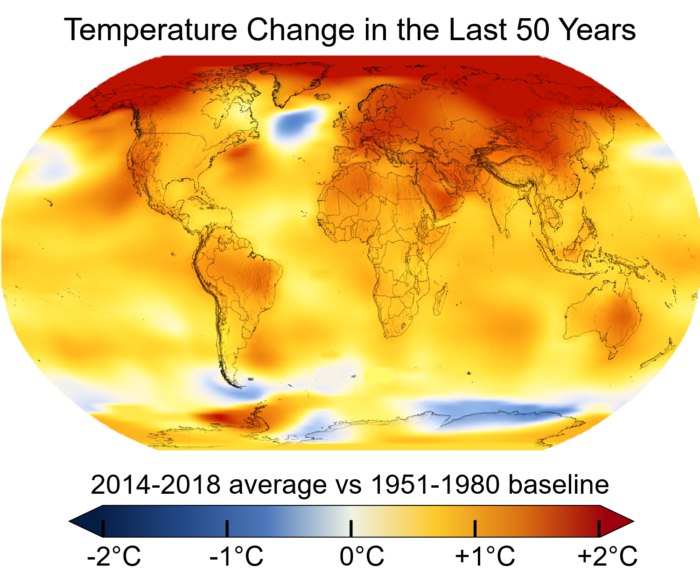
    Most of us talk about the weather every day. Fortunately, in the last few days the weather has settled and it doesn’t often rain. Anyway there’s been a lot to talk about. In Italy we lived through cloudburst and floods last month. Bad weather is nothing new. But it’s getting worse — and the uncomfortable fact is that it’s manmade. Manmade pollution from greenhouse gases is warming the atmosphere.

    Weather events that would otherwise be occasional, freak occurrences are now becoming commonplace. And let’s be clear: the scientific evidence is not in question. These risks were also laid out in last year’s comprehensive report, provided by the Intergovernmental Panel on Climate Change (IPPC) by the World Meteorological Organization in partnership with the United Nations. Lately, scientists have demonstrated over and over again that the steady rise in carbon pollution has been the primar y cause of the steady rise in global temperatures since the mid-20th century. There’s no evidence that natural causes, such as volcanoes or solar activity, have played a significant role since then. At this point in human history, we do more than talk about the weather, we’re actually influencing it. We know the solution. We need to end our dependence on dirty sources of energy like oil, coal and gas.


    Anyway at school our English teacher likes having the weather conversations because she hates rain and she can’t stand the unpredictable weather. Above all she detests wearing a cagoule or a parka or her windcheater. This year she has bought a wide range of raincoats (a Mackintosh is a must) in different colours for the occasion. She likes telling us the expression or words used to describe the precise nature of weather phenomenon and “believe” me they are many.

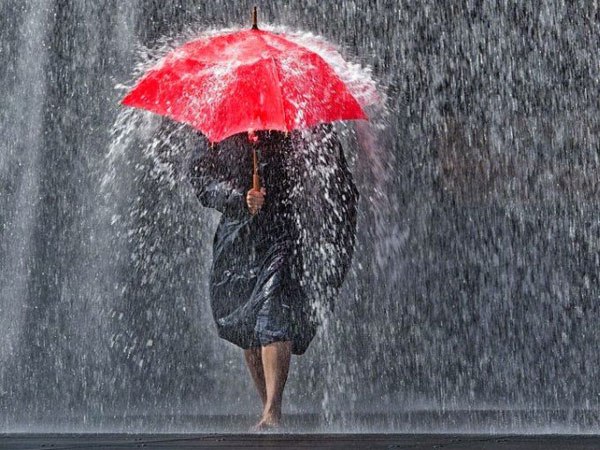
    When it’s raining very lightly, she often says: it’s drizzling, it’s mizzling or it’s spitting but when it rains heavily she used to saying: it’s pouring, it’s pelting or it’s bucketing and she gets really angry because she feels soaked and it’s damp everywhere.

    Last week we had three days of showers or a sort of cloudburst that caused the so called weather warnings  that made students stay at home in some areas at risk. This  emergency was the straw that made the camel’s back of her nerves.

    Anyway she also explained us the use of one the most common idiomatic expressions in Great Britain:” it’s raining cats and dogs”. According to some etymologists the explanation of this expression dates back to Odin, the Norse god of storms, who was often pictured with dogs and wolves, associated to the wind. Moreover, black cats, became signs of heavy rain for sailors. Therefore, “raining cats and dogs” may refer to a storm with wind (dogs) and heavy rain (cats).

    “Cats and dogs” may come from the Greek expression cata doxa, which means “contrary to experience or belief.” If it is raining cats and dogs, it is raining unusually or unbelievably hard.

    Cats and dogs” may be a misinterpretation of the obsolete word catadupe. In old English, catadupe meant a cataract or waterfall. In Latin, for example, catadupa was borrowed from the classical Greek κατάδουποι, which referred to the cataracts of the Nile River. So, to say it’s raining “cats and dogs” might be to say it’s raining waterfalls.

    A false theory but the most enjoyable stated that cats and dogs used to cuddle into thatch roofs during storms. and then be washed out during heavy rains. However, a thatch roof is naturally but relatively water resistant so when the animals went to seek shelter during a storm and to slip off the roof or they fell in the houses.

    In the last few days as the rains are moderate, she is getting used to say the expressions: the heavens have opened or lovely weather for ducks!

    In any case or the weather forecast promises ‘a bit of drizzle’, or ‘a few spots of rain’, or plenty of rain what is really important is having everything under control and enjoying splashing in puddles with a colourful pair of Wellington boots on.

  • HAPPY BIRTHDAY SLOW FOOD

    HAPPY BIRTHDAY SLOW FOOD

    Avete mai sentito parlare di Slow Food? Mangiare slow è una filosofia di vita che mette al centro del nostro vivere il mangiare sano ma non solo. Quest’associazione internazionale il 9 dicembre compirà 30 anni. Questo articolo sono certo vi chiarirà molte cose riguardo al costruire un mondo migliore a partire dal cibo.


    30 years have passed since that day in Paris, SLOW FOOD association gathered delegates from all over the world signed the Slow Food Manifesto (1989). A manifesto that for the first time spoke of the importance of the right to pleasure, which laid the foundations for a new way of understanding gastronomy and which made food an extraordinary element to influence not only the life of each of us, but of the whole planet.


    What is Slow Food exactly?

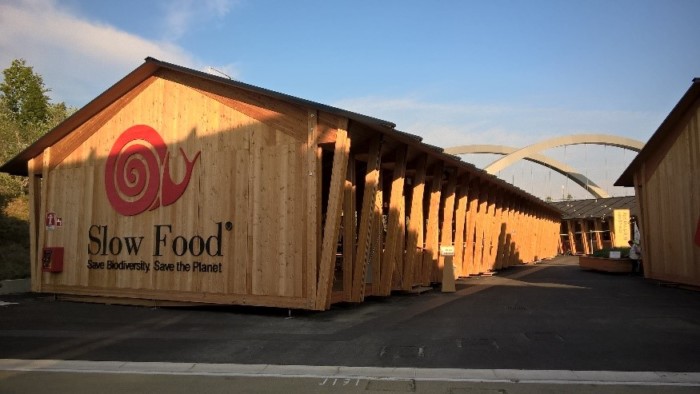
    Slow Food is an “eno-gastronomic” (wine and food) association committed to protecting traditional and sustainable quality foods, primary ingredients, conserving methods of cultivation and processing, and defending the biodiversity of cultivated and wild varieties.


    Why the name Slow Food?
    Slow Food means living an unhurried life, taking time to enjoy simple pleasures, starting at the table.


    Why the snail symbol?

    The snail was chosen because this mollusc moves calmly and it is used to eating slowly.


    Who founded this association?

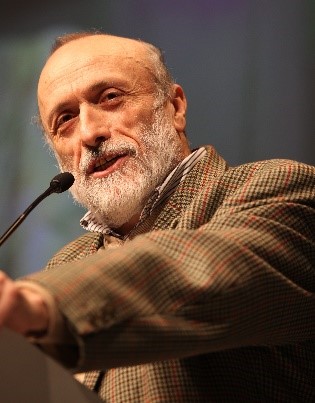
    This association was strongly desired by a food activist Carlo Petrini in the small northern Italian town of Bra in 1986. Its initial aim was to support and defend good food, gastronomic pleasure and a slow pace of life.


    Has Slow food a slogan?

    Yes, it’s intelligent claim is: GOOD, CLEAN and FAIR.

    • Good: tasty and flavorsome, fresh, capable of stimulating and satisfying the senses.
    • Clean: produced without straining the earth’s resources, its ecosystems and its environments and without harming human health.
    • Fair: respectful of social justice: from production to commercialization to consumption.

    The Slow Food movement has been shaped at every stage by a moral purpose: to determine what it is good to eat, having regard for the interests of producers, customers and the environment.


    Does Slow Food mean organic?
    No, it doesn’t.  Slow Food supports the principles behind organic agriculture, such as promoting methods that have a low impact on the environment and reducing the use of pesticides. Moreover, most of the Slow Food Presidia practice organic.


    What are Presidia?

    Presidia are projects established to save artisanal food products, native animal breeds, plant varieties, traditional farming and fishing techniques, ecosystems and rural landscapes at risk of extinction.


    How is Slow Food financed?

    The international association receives most of its funding from membership fees and contributions from sponsors.

    Today, more than then, we cannot pretend that what we eat does not affect our destiny.

    Today, more than then, we must act to prevent the loss of traditions and knowledge related to the production of that food capable of protecting ecosystems and social justice.

    In these 30 years Slow food projects have grown and are in the eyes of all models to follow, able to guarantee a future forthe communities.

    There is still a lot of work to do and for this we have to join the journey. We have to play our part in reshaping our styles of eating, the food system and help build a brighter future.

  • What you have to know about BREXIT.

    What you have to know about BREXIT.

    Come tutti sappiamo il 23 giugno 2016 c’è stato un referendum nel Regno Unito, per decidere se esso doveva lasciare o restare nell’Unione Europea. Il 51,9% degli inglesi ha deciso di distaccarsi dall’ Unione Europea.Cosa cambierà? Avrà delle influenti conseguenze sulla carriera dei giovani? Sarà più complicato per noi viaggiare verso l’Inghilterra?

    On 23 June 2016 a referendum was held to decide whether the UK should remain in the European Union or leave it. More than 30 million people voted and Leave won by 51.9% to 48.1%.

    A new word was created – Brexit –, which is a short way of saying, “the UK leaving the EU” by mixing the words Britain and Exit. But what does Brexit actually mean and how will it affect us all?

    The European Union is a club of 28 European Countries. Each of these countries pays to be a member and in return, they get access to special ways of working together. This includes being part of a “single market”, which means that countries can trade with one another and people can move around freely – as if we were all living together in one big country.

    The EU has its own parliament, laws and currency (the euro – although the UK does not use this as we stuck to our own pounds and pence). The EU was set up after World War 2 with the idea that if countries work together, they are unlikely to go to war again.

    The 48 per cent who voted to remain in the EU, including former Prime Minister David Cameron, felt that being a member of a 28-nation club is better than going it alone. They felt it was easier for us to sell things to other EU countries, meaning it was good for businesses and trade.

    So why did over half of voters (51.9 %) in the UK want to leave this special club?

    The idea of the single market was to increase trade between countries, creating jobs and lowering prices. However, the European Parliament decides on many rules and standards that EU countries have to follow and critics felt that they were losing control of their own affairs and laws.

    The UK pays billions of pounds in membership fees to the EU every year and some people felt that they weren’t getting much back in return for this.

    Also, many people are moving from poorer countries to richer countries around the world. This has made some people in the UK worry about the free movement rule, which allows people in the EU to move to any other EU country without needing special permission (a visa). This was a key issue for many voters and the Leave campaign won by just 4 per cent.

    Will young people still be able to get jobs in Europe?

    Britain’s membership of the EU means that citizens are able to live and work anywhere within the 28 countries of the EU and they do not need any special visa.

    How will it affect young people wanting to study at universities in Europe?

    Some young Britons have responded by choosing to study at significantly cheaper European universities, particularly in the Netherlands and Germany. More than 15,000 British students also study in Europe as part of the Erasmus scheme.

    After March 2019, students could still study outside the EU but it may be harder to get visas and fees may be more expensive.

    What did Prime Minister Theresa May say to reassure EU citizens?

    Prime Minister Theresa May issued a direct appeal to EU citizens living in the UK to stay in the country after Brexit.EU citizens and their family members living in the UK must apply to the for settled status. Settled status means that you can live in the UK for as long as you want. You will have access to public funds and services and you can apply for British citizenship. Any children born in the UK after you get settled status will automatically be British citizens.

    She agreed that any EU citizen arriving between March 2019 and 2021 will have a right to residency.

    They will get a “lifetime right” to bring in their entire close family, kids, spouse, parents, grandparents – even if they are outside the EU.

    They can also bring in their girlfriend or boyfriend – a “durable partner” if they can prove they have been together for two years.

    Children born in the UK to parents from the EU will automatically become British citizens.

    Irish citizens will not have their rights affected by Brexit and will always be able to live and work in Britain freely.

    Will they need visas to work there?

    EU citizens will still be able to travel to and live in Britain after Brexit under new immigration plans.

    What does this mean for EU citizens living in the UK?

    The report confirms that EU and UK citizens have free movement of rights until the day the UK withdraws from the EU – 29 March 2019. This, in effect, is the cut-off date for EU citizens moving to the UK.

    Anyone who arrives before Brexit day will have the right to stay.

    Those who are yet to be granted permanent residency in the UK will have their rights protected, so they can still acquire it after withdrawal.

    EU citizens in the UK will have equal access to social security, health care, education and employment.

    But they – and UK citizens in the EU – would lose their rights to residency if they are out of the country for five or more years.

    Passport or not after Brexit?

    The UK is still in the EU, but not in the Schengen area, so you will have to show your passport on entry. The fact that you are an EU citizen means that you will not need a visa.

    After 29 March 2019:

    1. You should have at least 6 months left on your passport from your date of arrival. This applies to adult and child passports.
    2. If you renewed a 10 year adult passport before it expired, extra months may be added to your new passport’s expiry date, making it valid for more than 10 years. Any extra months on your passport over 10 years may not count towards the 6 months that should be remaining to travel to most countries in Europe.